Fatherland (2026) | Review
The Oscar-winning Polish filmmaker turns Thomas Mann’s return to Germany into a haunting meditation on language, exile and complicity.

Paweł Pawlikowski’s Fatherland opens in 1949 with a return that turns homecoming into trespassing. Thomas Mann (Hanns Zischler) – Nobel laureate, perhaps the most internationally renowned German writer of the twentieth century and one of Nazism’s fiercest cultural opponents – arrives back in Germany after years of exile in Switzerland and the United States. Accompanied by his daughter Erika (Sandra Hüller), Mann travels through a nation now partitioned between the Allied West and Soviet East, where both sides seek to claim him as a symbol of the “real” Germany.
One of the first lines comes during a phone call between Erika and her brother Klaus Mann (August Diehl), who bitterly remarks that German is “a language created to lie in.” The line immediately establishes Fatherland’s preoccupation with a culture and language morally contaminated by fascism, but also introduces a deeper familial contradiction. Klaus’s disdain toward the German language hangs uneasily over a film centered on his father, a writer whose global stature and moral authority were built precisely through German literature. Though Klaus remains largely offscreen, his presence lingers throughout Fatherland like a ghostly counterpoint to Thomas Mann’s lingering belief that some version of Germany – cultural, literary or moral – can still be salvaged.
Hanns Zischler plays Thomas Mann with an imposing gravitas that never hardens into sanctimony. Pawlikowski’s Mann is intellectually unyielding yet visibly exhausted, a man returning to a language and culture he still belongs to but no longer fully recognizes. Though now an American citizen, he remains irreducibly a German writer. That contradiction sits at the center of Fatherland, a compact but remarkably dense chamber piece about exile, memory and the moral ruins of a nation attempting to culturally reconstruct itself after catastrophe.
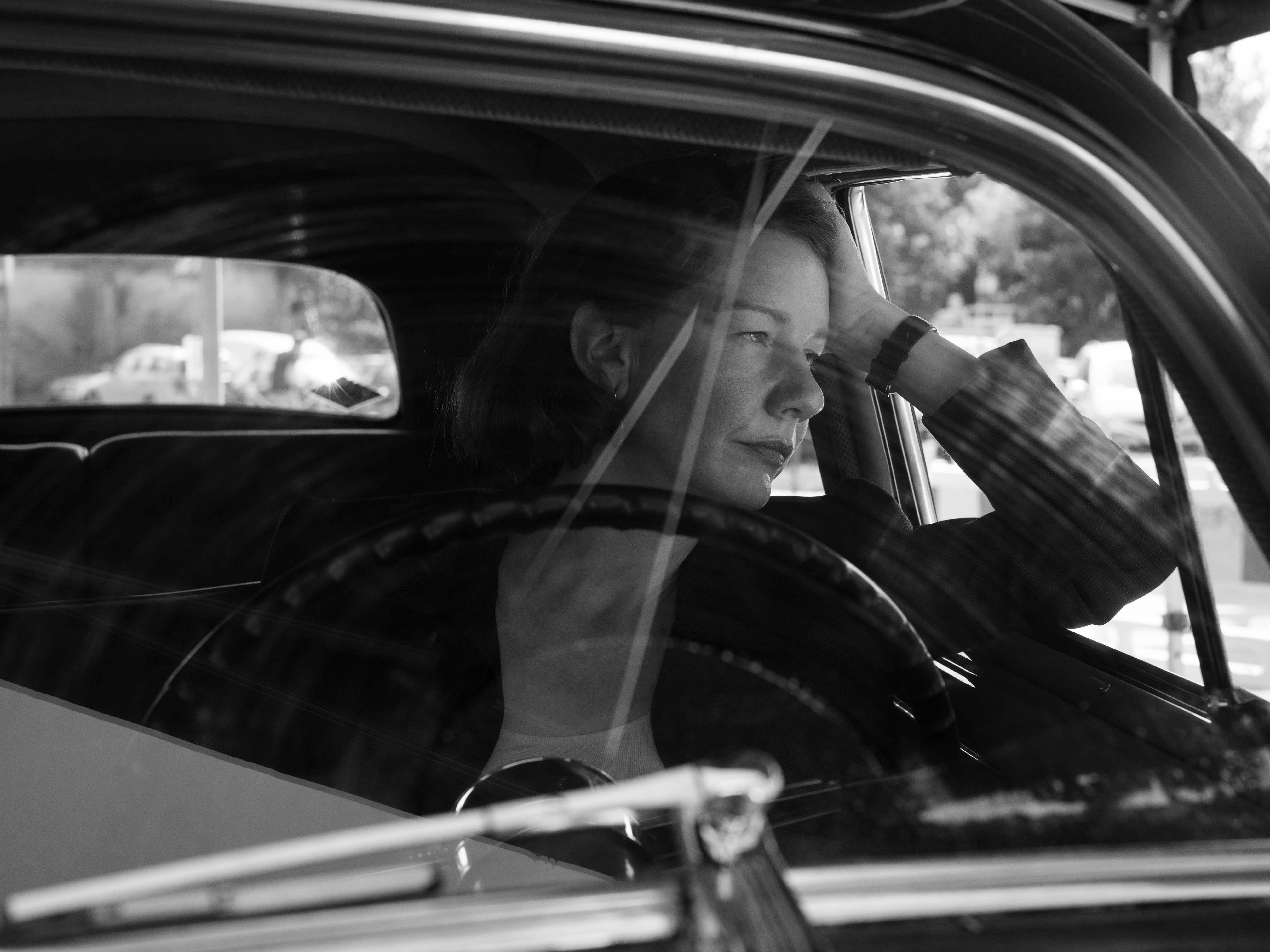
Equally compelling is Sandra Hüller as Erika Mann, continuing a remarkable streak of radically varied performances in recent years. Pawlikowski smartly refuses to reduce Erika to the role of dutiful daughter. She is at once caretaker, journalist, assistant and, in the film’s many travel sequences, effectively her father’s chauffeur as they move through a divided Germany thick with checkpoints and political suspicion. Hüller navigates these shifting roles masterfully, bringing a restless intelligence and emotional alertness to Erika that prevents the film from calcifying into a purely intellectual exercise. Through her, Fatherland gains much of its movement and nervous energy.
Beginning in Frankfurt, crowded with occupying Americans, informants and lingering wartime opportunists, Manns prepare to head for Weimar, in the Soviet-controlled East, to receive the Goethe Prize. Goethe becomes an almost spectral presence throughout: an emblem of a “good Germany” untouched by fascism, a cultural inheritance Mann desperately wants to believe can still exist. Pawlikowski avoids turning these debates into dry intellectual exercises. Instead, they emerge through tense encounters, conversations in hotel lobbies and uneasy reunions with figures who accommodated, enabled or simply survived the Nazi era.
One of the sharpest sequences sees Mann openly confront members of the Wagner family connected to the Bayreuth Festival, condemning not merely their proximity to Nazism but the ease with which Germany’s cultural elite now attempt to reintegrate themselves into polite society. Elsewhere, references to Erika Mann’s former husband Gustaf Gründgens – whose relationship with the Nazi regime remains heavily debated – and to her then-husband W. H. Auden deepen the film’s fixation on exile and compromised identities. Fatherland assumes a degree of historical literacy from its audience, but the references rarely feel ornamental; they reveal the dense web of artistic, political and moral entanglements that defined postwar Europe.
To call Fatherland a road movie would be misleading. Pawlikowski drains the genre of its liberatory impulse. Movement through postwar Germany is defined by checkpoints, surveillance and ideological scrutiny, every crossing carrying the tension of political negotiation. Even conversations feel monitored by history itself. The Germany Mann travels through is fractured geographically, morally and linguistically.
Visually, Fatherland continues Pawlikowski’s fruitful collaboration with cinematographer Łukasz Żal following Cold War. Żal’s black-and-white cinematography lends the film a severe elegance without tipping into nostalgia. The monochrome imagery emphasizes a country suspended between past and future, unable to fully bury one and uncertain how to construct the other.
Unlike many Cannes Competition titles eager to advertise their formal ambition, Fatherland finds confidence in precision and restraint. At just 82 minutes, Pawlikowski’s film wastes nothing. Rather than mistaking austerity for artistic seriousness, he relies on exacting performances, tightly controlled writing and the lingering power of unresolved historical wounds. The result is one of the festival’s most intellectually rigorous works – and among its most quietly devastating.
Fatherland had its world premiere at Cannes Film Festival, where it’s competing for Palme d’Or, on May 14, 2026.
Rating: ⚫ ⚫ ⚫ ⚫