The scarcity of recognition obscures talent’s ubiquity. Marty Mauser is a talented table tennis player, alright, one of those people who makes a niche look like fate. A Jewish New Yorker coming of age in the shadow of the Holocaust with a vision of himself too large to fit inside his body, Marty has an unparalleled gift that’s perhaps second only to his ego. The film’s real tension comes from the mismatch between that ego and the arbitrary, narrow system that rewards this particular kind of excellence, a sport most people still treat like a joke, governed by committees, legitimized by patrons, and remembered by almost no one outside of first place.
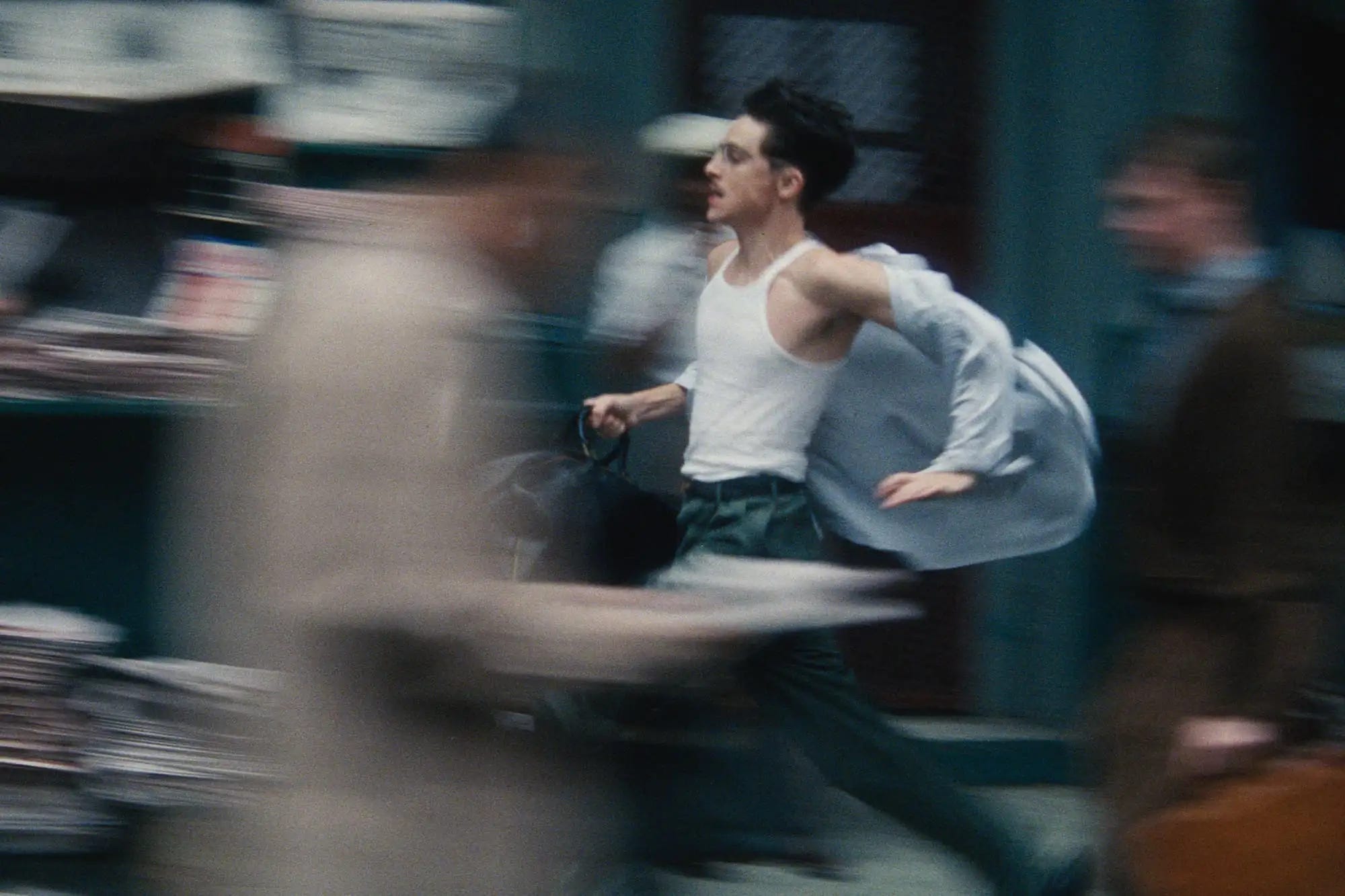
Josh Safdie and Ronald Bronstein’s script carves Marty as he hustles to scrape together the money to travel to London for the British Open, and then, later, to the World Championship in Japan. Along the way he ties his entire self-worth to his expectations, to an exit, a solution, a way out. It is as if his salesman id and ego are sharing custody over his agency, having completely ousted the superego from his psychological architecture. Shortsightedness is in the bones of this film. The almost claustrophobic shots offer only one way out, forward, onward. Safdie shoots Marty like a man in a corridor who keeps calling the corridor a horizon, sprinting toward recognition as if it can finally deliver what he actually wants, not victory, not money, not legacy, but a verdict on himself.
It’s unsurprising that this is Safdie’s first feature as a father. Spanning nine months, a gestational period, it translates the developmental stages of an embryo onto the destructive stages of an ego, just in time for Marty to metabolize the possibility of living for something greater than himself, and to recoil from it. Safdie makes that connection literal from the first minutes. In the shoe-store backroom where Marty works, a furtive encounter with his married childhood friend Rachel Mizler (Odessa A’zion) is visualized as sperm reaching for egg, the image then morphing into a table tennis ball, as if even conception must be converted into Marty’s private mythology of achievement. When Rachel becomes pregnant, he defaults to denial, “not mine,” and the film’s nine-month structure stops being a clever conceit and becomes an indictment.
To Marty Mauser, nothing is holy. Talking to the press ahead of his face-off at the British Open with the five-year world champion Béla Kletzki, a Holocaust survivor, Marty remarks: “Listen, I’m basically gonna do to Kletzki what Auschwitz couldn’t… I’m gonna finish the job.” Then he adds that he’s allowed to say it because he’s Jewish himself, “Hitler’s worst nightmare.” The line is not just ugly, it’s revealing. Marty’s relationship to history is not reverence, not grief, not responsibility, but permission. He treats inherited catastrophe as a credential, a shield that lets him say whatever he wants, whenever it serves him.
Kletzki takes the loss with a steadiness Marty can’t access, no sulking, no mythology, just proportion, and that dignity becomes its own rebuke. At dinner, Kletzki tells the Holocaust honey story, and Safdie doesn’t just let us hear it, he shows it, letting Kletzki’s narration ride over flashback images, staged with hushed reverence and a Daniel Lopatin score that doesn’t cue emotion so much as haunt it. He describes being spared because Nazi camp guards recognized his table tennis talent, sent out to dismantle bombs in the woods, and finding a beehive. He smokes the bees out, smears honey over his body, then lets his starving bunkmates lick it off for nourishment. Safdie told the Guardian the anecdote is based on a real survivor, Alojzy Ehrlich, and that he “learned more about the Holocaust in that little story than from some movies that are only about the Holocaust.” Safdie uses this tangent to show what it did to bodies, to dignity, to community, how survival can look like an intimacy you’d never consent to in any other world. Which is why Marty’s “Hang on, you’re gonna love this,” as he implores a wealthy businessman Milton Rockwell (Kevin O’Leary, Shark Tank’s Mr. Wonderful) to stay longer, lands as pure desecration, a command to enjoy what cannot be enjoyed.
The echoes and aftershocks of World War II weave through this story set in 1956, not even a decade after its end. Having defeated Kletzki at the British Open, Marty loses to Koto Endo in the final, a Japanese player, a young man deafened by wartime air raids. The world doesn’t remember seconds, especially not in table tennis. So Marty resorts to half-time acts at tournaments across the world, from my native Bosnia and Herzegovina to Egypt, turning his talent into a traveling performance, the very humiliation he sneered at earlier. In Egypt, he even chisels a piece off the Great Pyramid and brings it home to his mother as a gift. “We built that,” he remarks. It’s a joke with a blade in it, a grab for ownership, legacy, and grandeur, as if history itself can be pocketed and presented as proof of worth.
The dynamic between Marty and Milton Rockwell is further complicated by Marty’s affair with Rockwell’s retired actress wife Kay Stone (Gwyneth Paltrow). Marty Supreme, unlike The Brutalist or Foxcatcher, takes a more cynical, and frankly more realistic, view of artistic-athletic patronage, not as mutually, if asymmetrically, elevating proximity between money and talent, but as a blunt instrument. Marty is faced with a request from his would-be patron that cuts against his sense of self, and he refuses. What follows isn’t a moral lesson about hustling. It’s a lesson about power. Safdie isn’t studying petty scheming so much as the unmovable veto of money and those who wield it. Marty can be brilliant and still be disposable. He can be gifted and still be laughed out of the room.
It’s telling that Marty’s nemesis is Japanese, not because the film is making a simplistic “enemy” out of Japan, but because Marty is forced into proximity with the war’s other wound, one he can’t claim through identity. Mere years separate the dropping of the atom bombs and Marty finds himself one degree removed from a different horror of the same conflict, close enough to feel history’s heat, not close enough to feel accountable for it. That distance becomes his most human impulse and his most damning one, a kind of historical tabula rasa, an insistence on being freed from the burdens of the generation that came before him, while still using those burdens when they benefit him.
In the end, regardless of his talent, Marty is at odds with the system that recognizes it, a committee-patron complex, governing bodies, gatekeepers, and financing businessmen who decide what counts, what sells, and who gets to matter. Marty doesn’t get the recognition he craves, but he does get the vindication he needs to accept that he’s becoming a father, and that living for something greater than himself has finally entered the frame. Posterity draws him into his own people’s history, not as a credential but as a responsibility. The fight by proxy is no longer just for him, or even for his child, but for those he kept treating as a shield.
Rating: ⚫ ⚫ ⚫ ⚫ 1/2