Project Hail Mary (2026) | Review
Well, it’s an Amazon Basics spin on Interstellar, among others.

Recent film history has hardly been starved of ambitious science fiction concerned with space, alien encounter, and the limits of human knowledge. From Prometheus and Interstellar to Arrival, the genre has produced works drawn from cult franchises, original screenplays, and literary sources that managed to make scientific inquiry feel thrilling, urgent, and cinematically alive. It is against those now-canonical titles that Project Hail Mary arrives already at a disadvantage. Andy Weir’s source novel is built around the slow, repetitive, often dramatically inert grind of the scientific method, and what may read as procedural fascination on the page translates here into something stubbornly anti-cinematic. In the hands of Phil Lord and Christopher Miller, a directing duo more at home in glib irreverence than awe, the result is a slick but inferior screen version that often feels like an Amazon Basics approximation of superior modern science fiction.
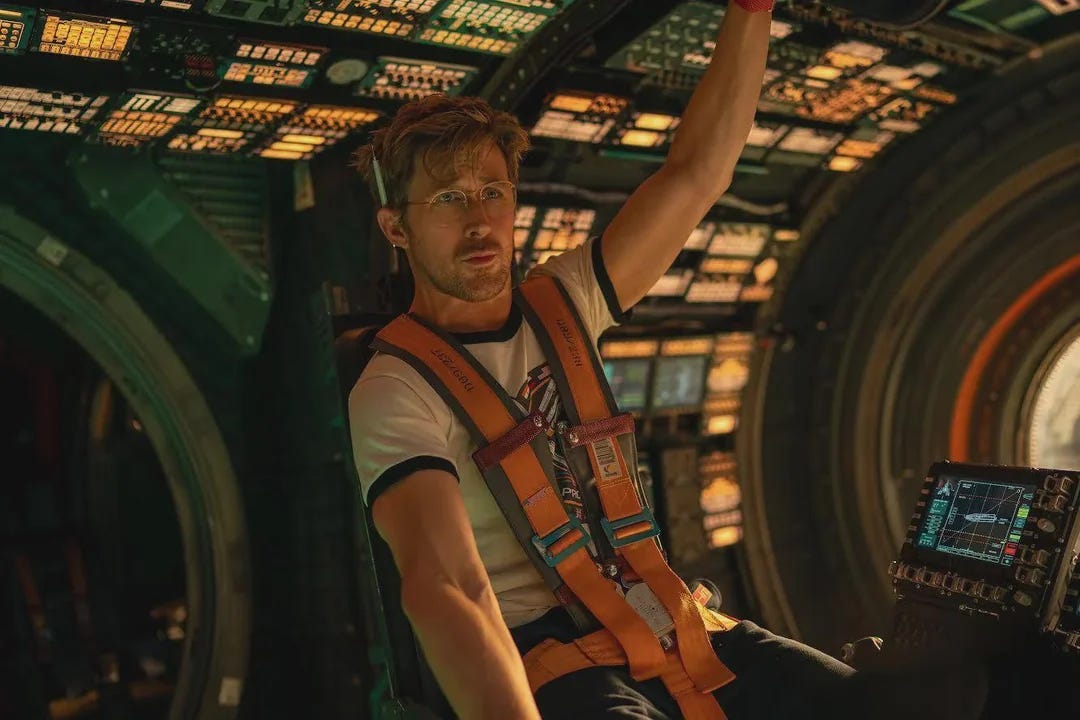
At its center is Dr. Ryland Grace, played with overextended goofiness by Ryan Gosling, a high-school teacher with a doctorate drafted into a mission to stop a single-celled alien organism from consuming the Sun and threatening Earth with catastrophe. The premise already asks for a great deal of suspension of disbelief, but the adaptation compounds that problem by framing Grace less as a convincing scientist than as a fantasy of scientific self-importance. He is a pick-me genius, a figure built around the adolescent wish that the world, having once failed to appreciate him, will one day beg for his return. His retreat from academia after challenging scientific dogma is meant to mark him as an outsider visionary. Instead, the script flatters the audience with a familiar technocratic fantasy that the maverick misfit was right all along and that institutions exist mainly to suppress brilliance until the apocalypse forces their hand.
More damningly, Grace is not even anchored to Earth by love, family, or any deep sense of belonging. He has no living relatives, no great attachments, nothing that might make his refusal of the mission tragic in any substantial sense. What the story instead gives us is the platonic ideal of a certain modern male hollowness: rootless, cowardly, governed by naked self-preservation, and apparently willing to gamble humanity’s future for the mere continuation of his own life, only to be later recast as heroic as though that moral smallness were merely another stage in a hero’s journey. Gosling’s performance leans hard into a recognizable contemporary type, all knitted cardigans and sensible sweaters, Converse, bicycle-riding awkwardness, colorful socks, and curated nerd charm, the aesthetic of a certain soft, extended adolescence masquerading as depth. The whole thing feels less like characterization than branding.
That same childishness extends to the story’s view of humanity under existential threat. As wars rage across the globe and international cooperation grows ever more threadbare in real life, Project Hail Mary asks us to believe that the world instantly unites, hands effectively unlimited authority and resources to a German administrator Eva Stratt, and efficiently mobilizes for interstellar salvation. This fantasy of planetary consensus might once have passed for optimism. Today, it plays as naïve bordering on delusional. The whole enterprise badly needs some grounding sense of political reality, especially when asking viewers to accept that humanity could pull off such staggering feats of coordination and space travel within a matter of years. Without that realism, the stakes never acquire weight. What emerges is less a serious thought experiment than a glossy bedtime story about competent institutions and obedient nations.
Sandra Hüller, to her credit, seems born to play someone like Stratt. She does a great deal with very little, lending severity, intelligence, and a kind of cold bureaucratic conviction to what is finally a rather one-dimensional role. The screenplay gives her function more than character, but Hüller’s presence at least suggests a harder, more interesting version of this material lurking somewhere beneath the surface, one less interested in reassuring us that the right experts will save the day than in interrogating the costs of giving them that power.
Then there is the alien itself, which reveals another limit of Weir’s imagination. One of the enduring challenges of science fiction is how to imagine life that does not merely resemble recombinations of earthly species. Yet the creature design here falls back on exactly that impulse, giving us something that feels like a rock-laced arachnid assembled from familiar biological cues. Rather than expanding the imagination, the film narrows it, asking us to marvel at something that never quite escapes the gravitational pull of Earth’s own visual archive.
The problem, though, is not only that Project Hail Mary borrows too liberally from better science fiction, but that the adaptation process itself exposes how thin its material becomes on screen. Weir’s novel depends heavily on Ryland Grace’s interiority, on the stop-start rhythm of amnesia, recollection, and retroactive self-understanding as his memories gradually return while the mission unfolds aboard the ship. On the page, that structure at least gives the character a psychological scaffolding. On screen, however, that internal back-and-forth is inevitably compressed, hurried through, and stripped of much of its introspective texture. What remains is not a richly fractured consciousness but a screenplay mechanism, a delivery system for exposition that shuttles between flashbacks and present-tense jeopardy with diminishing dramatic payoff.
It is difficult, in the end, to separate disdain for the adaptation from disdain for its source material. Weir’s limitations as a writer, already apparent in The Martian, become even harder to ignore here. His background as a software programmer turned pop-science novelist gives his work a rough-edged enthusiasm, but not the intellectual depth or narrative sophistication needed to sustain this kind of story. Weir is no Kip Thorne, the Nobel Prize-winning physicist whose work helped ground Interstellar, and Project Hail Mary is no Interstellar either. When the narrative pushes for transcendence, its desperation to manufacture feeling becomes unmistakable. The crescendo is staged in a way that is hard not to read as an echo of Interstellar’s “No Time for Caution,” a piece of orchestral, high-stakes spectacle designed to override thought through velocity and emotion alone. It is one of the adaptation’s more effective passages on a purely manipulative level, but also one of its most revealing. The uplift feels less earned than engineered, calibrated with the precision of a corporation that knows exactly which sentimental buttons to press. That is perhaps fitting for a studio backed by a company that has built an empire on predicting desire and monetizing impulse. Project Hail Mary does not arrive at emotion honestly. It extracts it.
This is the real failure of Project Hail Mary. It does not merely imitate better works, it diminishes what made them resonate in the first place. Where Arrival found mystery in language, where Interstellar reached for sublimity, and where even Prometheus, for all its flaws, had the courage of its own grandiosity, this one settles for competence, quirk, and corporate feeling. It resembles the ecosystem that produced it: sleek, efficient, consumer-tested, and expertly designed to simulate emotion while hollowing out the thing itself.
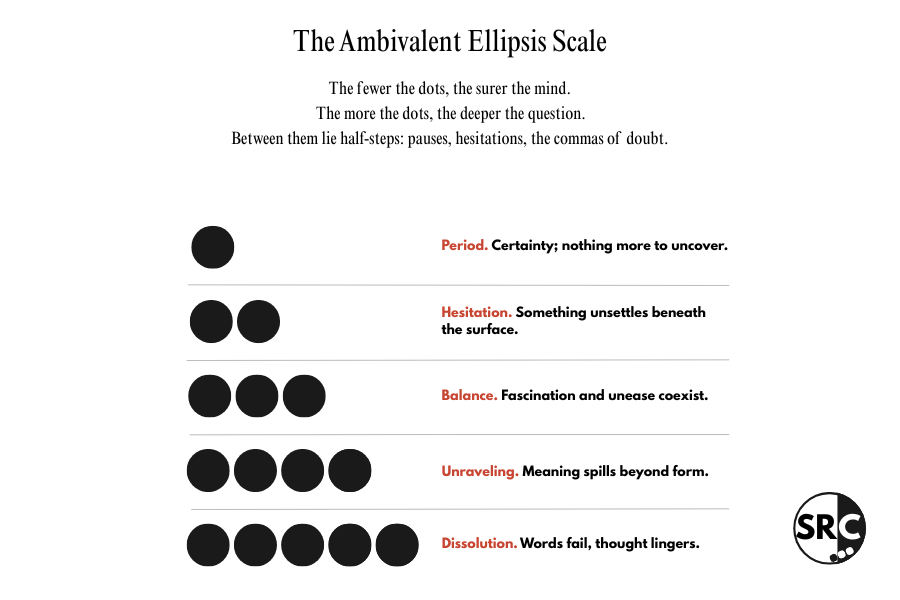
Rating: ⚫ ⚫